

The colobus monkeys are among the unique attractions that can be seen in various parks with in East Africa. Colobus monkeys are a group of old-world monkeys. The monkeys are popularly known for their striking colour and agile climbing abilities. Colobus monkeys are classified into several species, each with its specific behaviours, characteristics, and many more.
In this blog, we are going to classify more about different types of colobus monkeys including their behaviours, characteristics and many more.
What are colobus monkeys?
Colobus monkeys are a family of various kinds of monkey species that thrive with in the rain forests. These monkeys derive its name colobus from a Greek word which means mutilated.
The name is suitable for these monkeys due to their short thumbs. Colobus monkeys belong to the primate family with thumbs. The thumbs enables them to climb tree branches with utmost ease.
CLASSIFICATION OF MONKEY SPECIES
Western Black and White Colobus (Colobus vellerosus)
This is the most common type of the colobus monkeys and is easily identified with its striking black and white fur. These monkeys are generally found within the parts of West Africa. This type of monkey species is generally with a black body, long legs and white fur that is around their head.
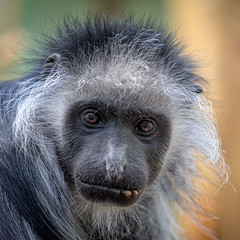
Their Behaviors
The male western black and white colobus monkeys are generally larger than the females.
Eastern Black and white colobus monkey. (Colobus Guereza)
The Eastern Black and white monkeys are another kind of the Colobus monkeys. They are sometimes referred to as Guereza and are mainly found with in East and central Africa such as Uganda, Kenya, Tanzania and Ethiopia.
The monkeys have a black body with white fur on the sides, back and tail. For this group of the colobus monkeys the males are larger than the females. They are generally herbivores feeding on plant leaves, fruits and seeds.
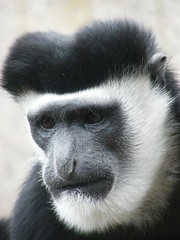
Red colobus monkeys
This is another popular species of the colobus monkeys. The Red colobus monkeys can be seen in central and East Africa (Uganda, Tanzania, Kenya and Congo basin).
Red colobus monkeys are popularly known for their reddish-brown fur that covers its whole body. They have long, slender limbs and a tail. They are generally social creatures living in groups of over 20 individuals. They also feed on leaves, fruits.
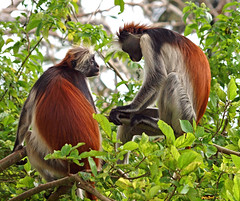
Olive Colobus monkeys
The Olive Colobus monkeys are among the species of the colobus monkeys and can be spotted within west Africa.
This type of the colobus monkeys are generally herbivores feeding on leaves and fruits. Olive monkeys have a greyish green fur and have a small under belly.
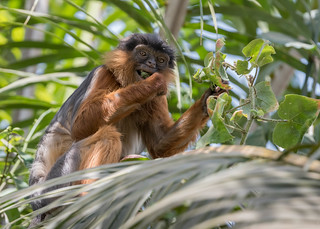
Golden Checkered colobus monkeys
Golden Checkered colobus monkeys are mainly found within the central parts of Africa covering countries like Democratic Republic of Congo. This is among the type of the Colobus monkeys. These monkey species usually prefer lowland forests that have dense vegetation. They are social creatures living in groups and a quite small compared to the black and white species.
Zanzibar red colobus monkeys
The Zanzibar red Colobus monkeys are also a type of the Colobus monkeys. Today they can be seen in the forests in Zanzibar however their population today is a bit lowering thus many classifying them as one of the endangered species.
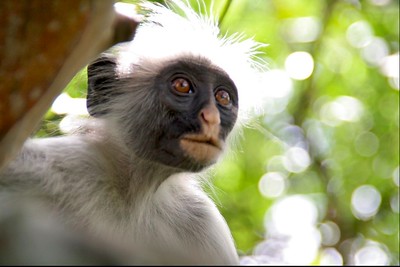
BEHAVIOURS OF THE COLOBUS MONKEYS
The Colobus monkeys are composed of different behaviours that can easily identify them from other monkey species. These monkeys are known for their complex social interactions and specialized feeding habits.
Social structure
Colobus monkeys are generally social animals that live in groups. The size of the group varied depending on the species. Despite the fact that they live in groups, the females remain with their birth group for their entire life unlike with the males.
Breeding period
The breeding period for these monkey species is generally the rainy season. The female monkey usually gives birth once every after 20 months and the gestation period is 4 to 6 months. The monkeys usually have a black and white colour that is for their adult hood. Infants are known to have a very close interaction with their mothers.
Colobus monkeys are becoming scarce due to the fact that poaching is on a high rate and even predators. Humans usually hunt these monkeys in order to attain fur and meat.
Their fur is of great importance due to cultural significance. However different projects have been set up in order to control threats to these colobus monkeys.
Our popular Tanzania-Rwanda safari packages
[/vc_column_text][/vc_column][/vc_row]
10 Day Wildebeest and gorillas vacation safaris

Embark on a captivating journey through the heart of East Africa as we invite you to explore the enchanting landscapes, vibrant cultures, and rich biodiversity of Rwanda and Tanzania. This meticulously crafted 10-day itinerary promises an immersive experience, seamlessly blending the awe-inspiring encounters with gorillas
| TRIP DETAILS |
| REQUEST INFO |
6 Day Wildebeest and gorilla trekking safari
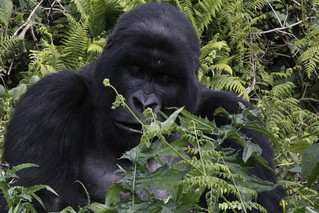
Book 6 Days Ngorongoro crater visit and Rwanda gorilla trekking to explore Tanzania & Rwanda on an Africa Safari experience tailored by Active African vacation the leading Safari operator in Uganda. The 6 Days Tanzania Rwanda Safari takes you to the great Ngorongoro crater reserve for an amazing wildlife experience.
| TRIP DETAILS |
| REQUEST INFO |
7 Day Rwanda-Tanzania vacation safari
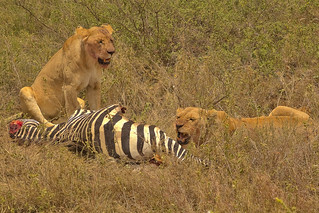
Depending on the degree of lodging, the time of year, and the particular parks and activities included a 7-day safari in Rwanda and Tanzania might have somewhat different costs. Along with activities to do in every park, below is a sample schedule including expected expenses for middle-class, budget, and luxury alternatives.
| TRIP DETAILS |
| REQUEST INFO |